Choosing flooring you won't regret in two years.
A patient honest comparison of the four floors a first-time homeowner is actually choosing between — hardwood, engineered, vinyl plank, and tile — by the room each one is built for, and the two-year regret list at the end.
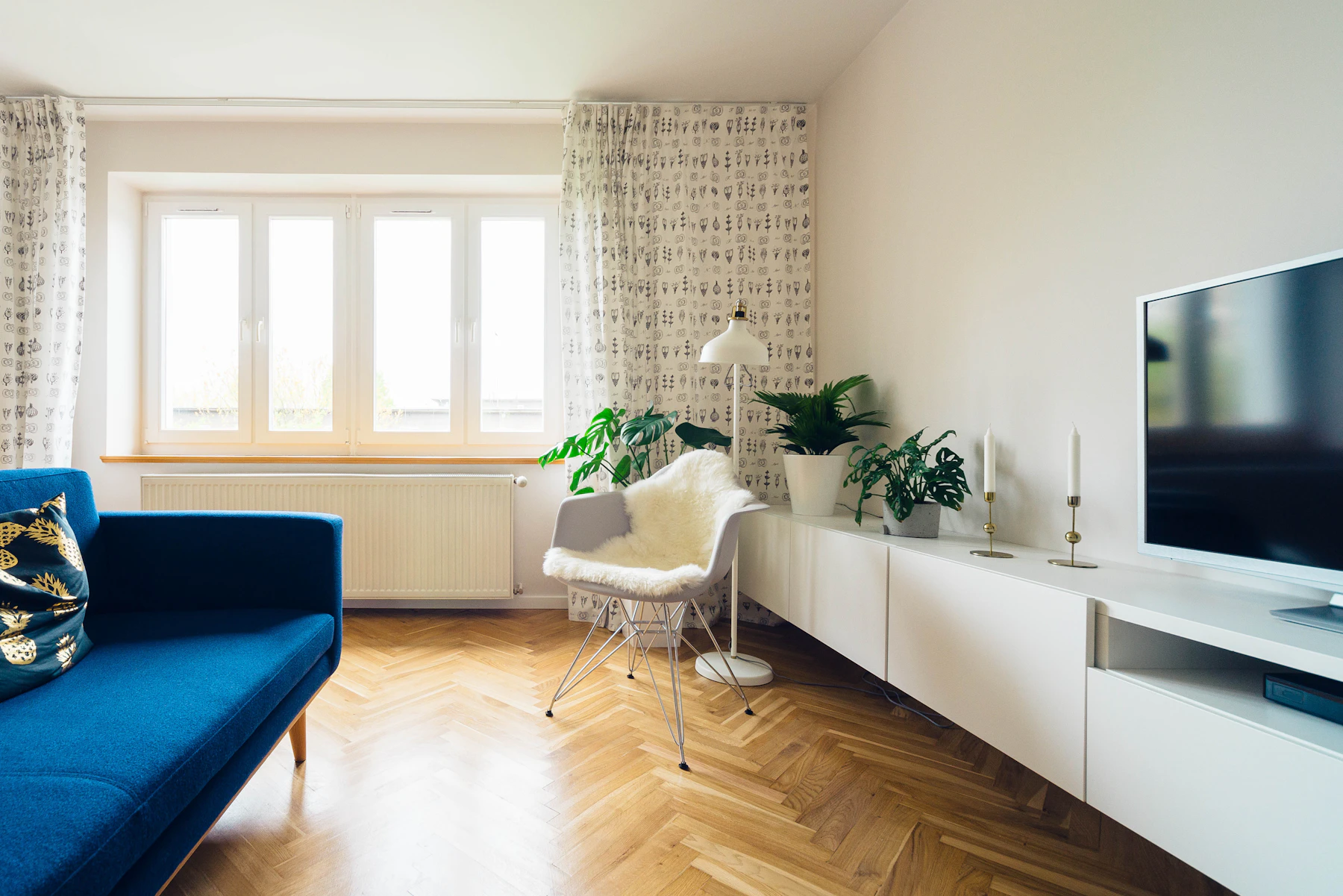
The floor in the kitchen of our 1920s bungalow is the third floor that room has known in three years. The first floor was the original oak, beautiful in 1923, sanded to within a millimeter of its life by 1998, and sitting at the end of its refinishable lifespan when we moved in. We replaced it, in the spring of our first year, with engineered hardwood that the salesman said had a “four-millimeter wear layer.” It turned out to be 1.6 millimeters and the salesman was lying. Eighteen months later, in the spot where the dog turns at the threshold and where the chair foot dragged across in October, the wear layer had given up. We replaced it again. The third floor, the floor that is in the kitchen today, is luxury vinyl plank in a pale oak look, and on the day my husband said I cannot believe how much I like this I did not say I told you so, because I had not, in fact, told him so — I had been against the LVP and then I had been wrong. The floor in your kitchen is going to be a decision you will live with for fifteen years. This piece is the patient version of how we now think about the four materials a first-time homeowner is actually choosing between, by the room each one is built for.
Most flooring conversations a first-time homeowner has are a small disaster of mismatched vocabulary. The salesperson at the lumberyard uses one set of words; the YouTube influencer uses another; the Instagram aspiration is dressed in a third. The four real materials in residential use today are solid hardwood, engineered hardwood, luxury vinyl plank, and tile. The other things you will be shown — laminate, bamboo, cork, polished concrete — are smaller-market alternatives that occasionally have the right room for them, but the four above cover roughly 92% of US residential floor sales in 2025, and the conversation is much calmer once you know which of the four you are actually choosing.
Read this on the Sunday morning before the lumberyard visit, with a coffee, a notebook, and a list of the rooms you are flooring. The decisions worth getting right are the ones you make at the kitchen table, not in the showroom under the salesperson’s bright light.
The four honest materials.
Each of the four materials in the table below is the right answer for some rooms and the wrong answer for others. The room is doing more of the deciding than the homeowner usually realizes — a powder room and a basement are not the same flooring problem, and the floor that is right for the living room is not necessarily the floor that is right for the kitchen six feet away.
$8–14 / sq ft installed
The fifty-year floor. The hard pick to get right.
Best for: living rooms · dining · bedrooms · halls
The genuine article — sawn boards of oak, maple, walnut, or hickory, three-quarters of an inch thick, nailed or stapled to a wood subfloor. Refinishable five to seven times across a century of life; that is the whole pitch. Hardwood expands and contracts seasonally, which is why it cannot be installed below grade (basements) or in genuinely wet rooms (full baths). For the living spaces above grade, in a house you plan to keep for a decade or more, hardwood is, in our experience, almost never the wrong answer.
- Material life 50+ yr (with refinishing)
- Refinishable 5–7 times
- Pets and kids Yes (oak), with grace
- Below grade · basements No — moisture
- Full baths No — standing water
- Powder rooms · kitchens Yes, with vigilance
- DIY install Possible · 3-day weekend
- Honest install range $8–14 / sq ft (Midwest 2026)
$6–11 / sq ft installed
The misunderstood category. Often the right answer.
Best for: bedrooms · halls · below-grade rooms · over radiant heat
A real hardwood wear layer (typically 2–4 mm thick) glued onto a plywood substrate. Stable across temperature and humidity in ways solid hardwood is not — which is what makes it the right pick over radiant heat, in basements, and in houses with hot/cold extremes. The 4-mm wear layer can be refinished once or twice; the 2-mm cannot. Engineered hardwood is what most builder-grade "hardwood" floors actually are; spec'd up to a 4-mm wear layer, it is genuinely a good floor for a long time.
- Material life 25–40 yr (depending on wear layer)
- Refinishable 1–2 times (4mm only)
- Pets and kids Yes, with the right finish
- Below grade · basements Yes — stable
- Full baths Marginal — not recommended
- Powder rooms · kitchens Yes
- DIY install Often easier than solid (click-lock)
- Honest install range $6–11 / sq ft
$4–8 / sq ft installed
The quiet revolution. Closer to right than people admit.
Best for: basements · mudrooms · rentals · kitchens · baths
Once the cheap fake-wood-look-floor of contractor-grade rentals, LVP has, in the last decade, become a genuinely good product in the upper tiers. The premium versions (Coretec, Karndean, Shaw Floorté) are completely waterproof, scratch-resistant, kid-and-dog-bulletproof, and visually convincing from the standing height most rooms are looked at from. The honest objection is that it is not wood; the honest counter is that for a kitchen, a basement playroom, a rental unit, or a mudroom that takes wet boots, the not-wood-ness is the feature.
- Material life 20–30 yr
- Refinishable No — replaced when worn
- Pets and kids Yes — the dream pick
- Below grade · basements Yes — waterproof
- Full baths Yes — actually waterproof
- Powder rooms · kitchens Yes — the easiest pick
- DIY install Genuinely easy — single weekend
- Honest install range $4–8 / sq ft (DIY: $2–4 material only)
Three cards for the three categories where most decisions actually land. Tile, the fourth material, gets its own conversation in section 05 — its installation is different enough (mortar, grout, waterproofing) that comparing it to the wood-look products in cost-per-square-foot terms is a category error.
Solid hardwood — when it is right, when it is not.
Solid hardwood is sawn boards of an actual hardwood species, three-quarters of an inch thick, nailed or stapled directly to a wood subfloor. The pitch is fifty years. The honest delivery on that pitch is closer to a century in well-cared-for installations; we have stood in 1890s farmhouses in central Illinois with the original oak still in place, refinished five times, looking nearly new on the sixth. No other residential floor material has anything close to that lifespan.
The constraints are real. Solid hardwood is a hygroscopic material — it absorbs and releases water with the seasonal humidity in the room — and it will, every winter, contract by a small visible fraction of a millimeter at each board joint, and, every summer, expand back. This is fine in any room where the moisture stays within normal household ranges. It is not fine in a full bathroom (standing water and 80% relative humidity for an hour after a shower) or in a basement (slab moisture coming up through any imperfection in the vapor barrier). For everything else — living rooms, dining rooms, bedrooms, halls, even the kitchen if you accept the small risk of a spill ruining a board — solid hardwood is, in our experience, almost always the right answer.
Oak, maple, walnut, hickory — the four species worth knowing.
Red oak and white oak are 80% of the US residential hardwood market for good reason: they take stain well, refinish predictably, and have a grain structure that hides small dings instead of advertising them. White oak is the slightly more popular pick now (subtler grain, warmer undertone). Maple is the second most common; harder than oak, but it stains unevenly — the right pick if you want a natural blond finish, the wrong pick if you want it dark. Walnut is the rich-brown showpiece; softer than oak (it dents more easily) and twice the cost. Hickory is the toughest residential hardwood; if you have large dogs and a country house, hickory is the floor that will survive both.
The refinishing question.
The reason solid hardwood lasts a century is that you can sand it back to fresh wood and refinish it every fifteen to twenty years. The cost: about $3 to $5 per square foot for a professional refinish, or roughly half that for a DIY job that is, in our experience, harder than most homeowners expect. (We have written about that — the small inventory of what we wish we had known before sanding ours is in our other floors piece, what I wish I knew before I sanded our floors.) A solid hardwood floor that has been refinished four times in its life has roughly half a sand-back’s worth of wear layer remaining; the fifth refinish is the last one before replacement.
Engineered hardwood — the misunderstood category.
Engineered hardwood is the category first-time homeowners are most often surprised by. The structure is a thin layer of actual hardwood — the wear layer — glued onto a multi-ply plywood base. The wear layer can be anywhere from 0.6 millimeters (cheap builder-grade) to 4+ millimeters (premium). The wear layer thickness is the single most important spec, and almost no salesperson volunteers it.
A 0.6-mm wear layer cannot be refinished and has a useful life of about ten to fifteen years; a 2-mm wear layer can be light-sanded once and lasts twenty; a 4-mm wear layer can be refinished once or twice and approaches the lifespan of solid hardwood. The pricing tiers track this: a $3/sq ft “engineered hardwood” at the big box store has the 0.6-mm wear layer; a $9/sq ft engineered at a real lumberyard has the 4-mm. The two products are completely different floors despite being called the same thing. If you are considering engineered, ask, in writing, what the wear-layer thickness is. The answer should be a number in millimeters; if it is not, walk away.
Where engineered actually wins.
Engineered hardwood is the right pick over solid hardwood in three specific situations: below-grade rooms (basements with proper vapor barriers — the plywood substrate is much more stable than solid wood); radiant-heated floors (the dimensional stability under temperature swings is genuinely better); and houses with extreme humidity swings (older homes without modern HVAC, summer cottages, anything where the room goes from 30% RH in winter to 70% in summer). For every other application, solid hardwood is the equal or better choice; engineered is, in those rooms, an answer to a question solid hardwood was not asking.
Luxury vinyl plank — the quiet revolution.
I had been against LVP for most of my professional life. The cheap stuff was — and still is — genuinely dispiriting; the seam patterns repeated every eight boards, the photograph of the wood grain was visibly a photograph, and the click-lock joints came apart in years. The premium category that has emerged in the last decade is a different product. Coretec, Karndean, Shaw Floorté, Cali Bamboo’s premium LVP lines — these are completely waterproof, dimensionally stable across temperature and humidity, photographically convincing at the standing-eye distance most floors are looked at from, and bulletproof against the small wear that everyday life inflicts on a floor.
The honest objection is that it is not wood. The honest counter is that the rooms where wood is genuinely the right material — the living room, the bedroom, the dining room — are also the rooms where you will spend the most time looking at the floor up close, in good light. The rooms where the wood-versus-LVP question actually matters less are the rooms where the LVP shines: basements, mudrooms, kitchens, full bathrooms, rentals, anywhere with kids or large dogs. In those rooms, the waterproof + scratch-resistant + dimensionally stable spec sheet of premium LVP is, in our practical experience, almost always the right call.
DIY install — the easiest of the four.
LVP is the DIY-friendliest of the four flooring categories. The click-lock plank system requires no glue, no nailing, no special subfloor prep beyond a clean flat substrate. A small toolkit — a tapping block, a pull bar, a utility knife, a small jig saw for fitting around door casings — runs about $35. A 200-square-foot room can realistically be done by a capable first-timer in a single Saturday. The material cost (premium LVP) is $2 to $5 per square foot at a real flooring store; the installed cost difference between DIY and professional is genuinely significant on this material in a way it is not on hardwood.

Tile — for the rooms that need it.
Tile is the fourth material and the one that lives by its own rules. Ceramic and porcelain tile are completely waterproof when properly installed (with a real waterproofing membrane beneath, not just thinset on subfloor); they are infinitely scratch-resistant; they are aggressively cold underfoot in winter unless paired with radiant heat; and they are, with the exception of the largest-format porcelain planks, almost impossible to make look anything other than tile. The rooms tile is right for are the rooms that need its waterproofness and do not need it to disappear.
Full bathrooms, mudrooms, laundry rooms, walk-in pantries, the area of a kitchen directly in front of the sink — these are the rooms where tile is the honest answer. (For an entire kitchen, premium LVP has, in the last decade, largely overtaken tile in our recommendations; the LVP is warmer underfoot, easier to install, and visually flexible in ways that tile is not.) The cost to install tile is much higher than the cost to buy it — typically $7 to $14 per square foot for a real tile setter, on top of $2 to $8 for the tile itself — and the install is by far the most skilled of the four flooring categories. Tile is the floor you almost always pay a pro to set.
The room-by-room cheat sheet.
The four materials, mapped onto the rooms of a first-time-homeowner’s house. This is the cheat sheet we tape inside the closet door when we are renovating.
- Living room, dining room, bedrooms. Solid hardwood, almost always. Engineered hardwood with a 4-mm wear layer if the house has radiant heat or aggressive humidity swings.
- Kitchen. Premium LVP in 2026, in our updated recommendation. Solid hardwood acceptable if you are vigilant about spills.
- Full bathroom. Tile, with a waterproofing membrane. Premium LVP acceptable in secondary baths if budget is tight.
- Powder room. Tile (small footprint, makes the room feel solid) or solid hardwood (continuity with the rest of the floor).
- Mudroom, laundry, entry from garage. Tile or premium LVP, both honest. LVP is warmer underfoot.
- Basement (finished). Premium LVP, almost always. Engineered hardwood acceptable with a proper vapor barrier.
- Hallways, stairs. Whatever matches the rooms they connect. Continuity matters more than the perfect material here.
The single most-asked follow-up question: do all my floors have to match? The honest answer is no, but the transitions should be deliberate. Stone-to-wood at a kitchen-to-living-room threshold; LVP-to-hardwood at a mudroom-to-hallway. The transition strip at the doorway is a $14 piece of trim that turns two different floors into a story instead of a mistake.
The two-year regret list.
We have a small private list of flooring decisions we have watched first-time homeowners regret within two years. It is not the obvious mistakes; the obvious mistakes (cheap laminate, the wrong species for the room) regret themselves. The list below is the quiet regrets — the decisions that looked right on a Saturday and were unwelcome by the second autumn.
- Dark hardwood in a small north-facing room. The room reads as a cave eight months of the year, regardless of the lighting added afterward. The medium-tone choice is almost always more forgiving across light conditions.
- The cheapest engineered hardwood at the big box store. The 0.6-mm wear layer gave up at the eighteen-month mark in the room with the dog; the salesperson was no longer available to ask. The 4-mm wear layer at a real lumberyard, for $3 more per square foot, is the smaller regret.
- Tile through an entire kitchen. Cold underfoot in winter; standing on it for an hour cooking is genuinely tiring; the grout shows every dropped tomato sauce within a year. Premium LVP in the cooking zone, tile only at the sink, is the version we now recommend.
- ”Bamboo” flooring. Marketed as sustainable, sold as cheap, performs as the worst hardwood in dimensional stability. Hard pass.
- Solid hardwood in a basement. The humidity will, eventually, win. Engineered or LVP belong below grade.
- Mismatched plank widths across adjacent rooms. If the living room is 5-inch oak and the dining room is 3-inch oak, the eye reads the transition as a mistake even if it cannot articulate why. Match widths across connected rooms; vary species if you want a transition.
The floor in your kitchen is, in honest terms, a fifteen-year decision. Choose it like one. The salesperson at the lumberyard wants to sell you a floor today; the floor you will live with on a Tuesday in 2039 is the one you should be choosing for. Match the material to the room. Ask for the wear-layer thickness in millimeters. Walk on a sample for an hour at the showroom in your socks. Pick the floor that the room — not the Pinterest board, not the salesperson, not the magazine spread — is asking for.
The right floor in the right room is the most invisible thing in any house. It does its job for fifty years, and you barely notice. That is the whole goal.