Your first month of tools, in order.
Eleven tools a first-time homeowner actually needs — bought one weekend at a time, in the order the house teaches you to need them. None of them costs more than fifty dollars at a real hardware store.

The first tool we sold the most of, in my grandfather’s hardware store, was a 200-piece home repair kit in a molded plastic case. The second was a hammer. The third was the same 200-piece kit, returned a week later by the same person, who was now back for the hammer. I watched this happen, on Saturdays, for twenty years. The first toolkit a new homeowner needs is not a kit; it is a list, in order, that the house writes for you across the first four weekends you live in it.
This is that list. Eleven tools, sequenced by when each one becomes the thing you cannot get the next thing done without. Some of them you will buy in the first weekend, before the moving truck has pulled away. Some of them will sit on a shelf for three weeks until the house asks for them. None of them costs more than fifty dollars at a real hardware store. All of them are worth being a brand you have heard of.
The total, if you buy every one of them at the high end of a real price, comes to $258. The 200-piece kit at the warehouse store is $179. The math, before you walk out, is not as good as it looks.
| When | Tool | Real price | |
|---|---|---|---|
| Week 1 | 25-ft tape measureStanley FatMax or Milwaukee | $18 | |
| Week 1 | 16 oz curved-claw hammerEstwing or Stanley | $22 | |
| Week 1 | 6-in-1 multi-bit screwdriverKlein 32500 or Stanley | $14 | |
| Week 1 | Assorted drywall anchors (box)TOGGLER or generic | $9 | |
| Week 2 | 24-inch levelEmpire or Stabila | $24 | |
| Week 2 | Utility knife + 10 bladesStanley or Milwaukee | $12 | |
| Week 2 | 8-inch adjustable wrenchCrescent or Channellock | $16 | |
| Week 3 | 12V or 18V cordless drill (1 batt.)Ryobi, Bosch, or DeWalt | $79 | |
| Week 3 | Stud finder (electronic)Franklin ProSensor or Zircon | $22 | |
| Week 3 | 10-inch tongue-and-groove pliersChannellock 430 | $24 | |
| Week 4 | Non-contact voltage testerKlein NCVT-1 | $18 | |
| First-month total · all eleven | $258 | ||
Prices are real January 2026 hardware-store figures, not list MSRP. Buy the named brand where it is listed; the off-brand version of any of these is a tax, not a saving.
Week one — the four day-one tools.
The day the keys are in your hand, four tools earn their place on the kitchen counter. Three of them you will use within forty-eight hours; the fourth, within a week. Buy them on the way home from the closing, if the closing was in the morning, or on the way to the house the next day, if it was in the afternoon. The hardware store is not far. The tools are not expensive. You are about to need them.
The tape measure.
A 25-foot tape — Stanley FatMax or a Milwaukee equivalent — for about $18. Twenty-five feet is the length that covers an interior room, a hallway, a garage stall, and the width of a king mattress all at once. Sixteen feet is too short the first time you measure a long wall. Thirty-five feet is heavier than you want in a pocket. Twenty-five is the answer. Avoid anything with a soft-touch grip that says “professional” on the package; the cheap part is the tape, not the case, and a bad blade will buckle the first time you measure ten feet by yourself.
The hammer.
A 16-ounce curved-claw hammer, wooden handle if you can find one, fiberglass if you can’t. Twelve dollars to twenty-two dollars. The 20-ounce framing hammer in the same aisle is heavier than your wrist wants at the end of an afternoon; the 8-ounce tack hammer is for picture frames and nothing else. Sixteen ounces is the hammer the house is asking for. Buy one good hammer once, and you will not buy another one for thirty years.
The screwdriver.
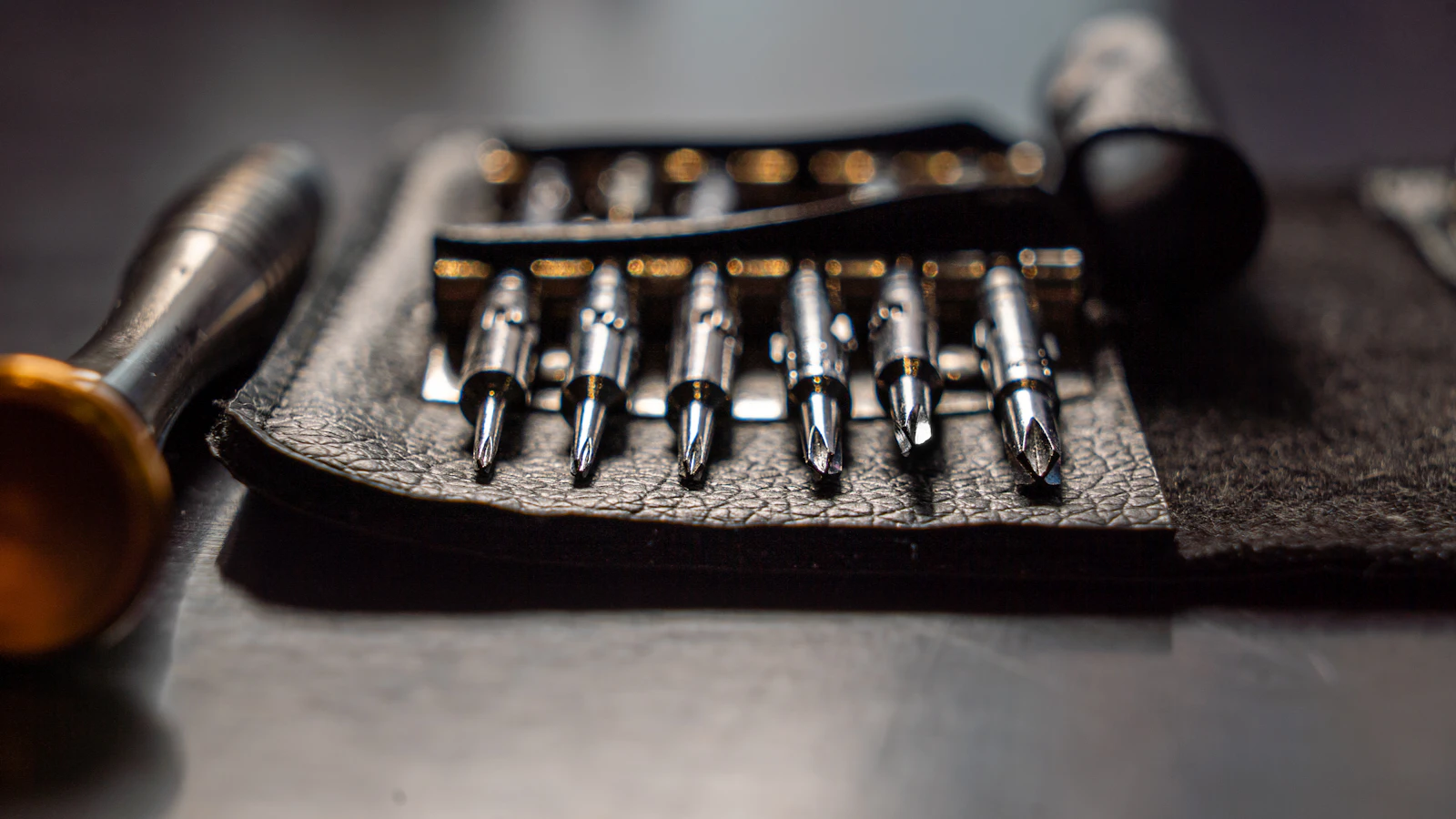
A 6-in-1 multi-bit screwdriver, the kind that stores two double-ended bits inside the shaft. About fourteen dollars. This single tool replaces four screwdrivers — Phillips #1, Phillips #2, flat 1/4”, flat 3/16” — and covers ninety percent of every screw you will turn in the first six months. Klein and Stanley both make a good one. The off-brand version at the dollar store is worse than nothing; the bits round out the second time you lean on them.
The drywall anchors.
A small assorted-size box of self-drilling drywall anchors, about nine dollars. Not the brass kind, not the toggle kind — the white plastic self-drilling ones with a flat Phillips head. The first thing you try to hang that is heavier than a picture frame is going to fall the first time. You will discover, in that moment, that the wall it is hanging on is hollow, and that the nail you put through it was holding nothing but paint. The drywall anchors are the answer; the fastener weight chart for drywall anchors and toggle bolts in our just-in-case-drawer guide spells out what each anchor type actually holds. Keep the box in the kitchen drawer, not the basement; you will reach for it in the middle of a Saturday afternoon, with the picture leaning against the couch, and you do not want to go looking for it.
Week two — the surprise tools.
Week two is the week the house starts asking for tools you did not know were tools. The picture frames are up; the boxes are mostly unpacked; and three small problems have already revealed themselves. The bathroom faucet is loose. The two pictures you tried to hang in a row are not in a row. The boxes you are still cutting open are dulling the kitchen knife because you keep using it as a box cutter. Three more tools, about fifty dollars together, and you are caught up.
The level.
A 24-inch torpedo or box level, about twenty-four dollars. Avoid the 9-inch torpedo level for now — it is too short to span the gap between two picture hooks. Twenty-four inches is also the length that fits diagonally in a kitchen drawer, which is where it will live. The bubble accuracy on a $24 level is, in practice, indistinguishable from the bubble accuracy on a $90 level. The expensive one is built for a contractor who drops it twice a week. You will not drop yours twice a year.
The utility knife.
A retractable utility knife with replaceable blades, about twelve dollars, plus a ten-pack of replacement blades. The blade is the tool; the knife is the handle. You will use this for opening boxes, scoring drywall before a clean snap, trimming a stubborn bead of caulk, opening the plastic clamshell packaging your next tool comes in. Change the blade the moment it starts dragging. A dull utility knife is the most dangerous tool in this article, because you push harder, and then it slips.
The adjustable wrench.
An 8-inch adjustable wrench, sometimes called a crescent wrench, sixteen dollars. The first time you reach for it is the kitchen faucet that has wobbled itself loose at the base. (It is almost always a nut under the sink that has backed off; tighten it gently, by hand, until it stops, then a quarter turn more with the wrench.) The 10-inch wrench is the more useful long-term tool, but it does not fit under most sinks; the 8-inch fits everywhere and is fine for everything in the house that is not a plumbing main shutoff.
Week three — the first project tools.
Week three is the week you commit to a project. It might be a TV mount. It might be a set of floating shelves above the couch. It might be the leaking outdoor faucet you noticed the first time you mowed the lawn. Whichever one it is, you have arrived at the part of the list where the screwdriver and the hammer stop being enough. Three tools, about $125 together, and the door to actual weekend projects is open. (Once that door is open, the project toolkit for that first weekend project — clamps, a hand saw, a respirator — earns its place on a separate shelf.)
The cordless drill.
A 12-volt or 18-volt cordless drill, with one battery, in the seventy-nine to ninety-nine dollar range. The single decision that matters is the battery platform. Whichever brand you buy your first drill in, every cordless tool you buy for the next ten years will need to share that battery — the impact driver, the trim sander, the leaf blower you do not yet know you want. Pick the platform on the brand, not the drill. The four ecosystems below cover roughly 95% of the cordless-tool market in 2026.
| Platform | Drill price |
|---|---|
| Ryobi (Hyper Green)18VMost first-time homeowners. The biggest, cheapest battery ecosystem on the market. | $79 |
| Bosch12VTighter spaces and lighter weight. The drill that lives in a kitchen drawer. | $99 |
| DeWalt (20V Max)20VIf you suspect you will outgrow Ryobi inside a year. Common on job sites. | $129 |
| Milwaukee (M18)18VProfessional ambition. The platform most contractors actually carry. | $149 |
Drill prices are entry-level kits with one battery and a charger, January 2026. Ecosystem counts are roughly the number of cordless tools in the same battery family — the number you care about is whether the platform makes the tools you will buy in years two and three.
The stud finder.
A basic electronic stud finder, twenty-two dollars. The magnetic ones — the small white pucks that snap to a drywall screw — are charming and twelve dollars and they work, sometimes. The electronic ones beep at a stud and beep again at the other edge of it; they cost ten dollars more, and the ten dollars buys you not putting three holes in the wall before you find the right spot. Calibrate it on a known stud (the wall next to a doorframe, which always has one) before you trust it on a long blank wall.
The tongue-and-groove pliers.
A 10-inch Channellock 430 — the original tongue-and-groove pliers, the blue handle, the one with the bevel-tooth jaws. Twenty-four dollars. This is the tool that fits the sink trap, the hose bib, the hex nut on the back of a kitchen faucet, the plastic ring that holds the toilet supply line on. The adjustable wrench in your week-two pile is fine for small nuts; the Channellock is for everything bigger than your thumb. The knockoff version at the warehouse store works once, then the rivet at the joint loosens. Buy the original. They are made in Meadville, Pennsylvania, and they outlive their owners.
Week four — the earned tool.
The eleventh tool is the one you buy after the first time you take a switch plate off a light switch to look at the wires behind it. It is also the tool that will, more than any other on this list, save you from a small but real chance of getting hurt.
The non-contact voltage tester.
A simple pen-style non-contact voltage tester, about eighteen dollars. Klein NCVT-1 is the standard. The way it works is uncomplicated: you put the tip near a wire, or a switch, or an outlet, and if there is live current within an inch of the tip, it lights up and beeps. You use it twice — once before you touch the wire, and once after you have turned the breaker off, to confirm the breaker you turned off was the right one. That is the entire ritual. The first time the breaker you flipped turns out to be the wrong breaker, you will understand why this tool is on the list. The second time will not happen, because you will check.
What we deliberately left off.
A list of eleven tools is also a list of every tool that did not make it. A few were close. A few are the right answer in month three. None of them belong in month one.
A power circular saw, miter saw, or jigsaw.
The first weekend you actually need one of these is also the first weekend you should consider whether the cut you are about to make is one you want to make in a hurry. Power saws are the right tool for the right project; they are the wrong tool for an emergency. Buy your first one for a specific job, not in advance.
A step ladder taller than four feet.
Worth owning, but a small two-step is enough for the first month. A six-foot A-frame is the right second-month purchase, when the ceiling lights or the smoke detectors actually demand it. Until then, a sturdy chair works (it does not, really, but it works).
A full socket set.
You will use, in the first year of homeownership, exactly three sockets: a 7/16”, a 1/2”, and a 9/16”. A $79 socket set has the three you need and forty-eight you do not. When the day comes that you need them, buy the set; it is fine to wait.
A toolbox.
The eleven tools on this list fit in a kitchen drawer, which is the right place for them. A toolbox is the second-year purchase, when the count has grown past twenty and the drawer is the wrong shape. A 19-inch plastic toolbox with a single tray, twenty-two dollars, is the answer when the answer is needed.
The fifty-dollar rule.
If you take one rule away from this piece, take this one: no tool on this list should cost more than fifty dollars, and most of them should cost less than twenty-five. The cheap version of any of these is a tax; the expensive version of any of these is a vanity. The middle is where they live. Stanley, Klein, Channellock, Milwaukee, Ryobi. A hardware store with a person behind a counter who has been there for ten years. The list, written out, on a folded piece of paper in your wallet. One weekend at a time.
My grandfather, the last time I worked a Saturday shift at his store before he sold it, watched me ring up a man who had walked in with the receipt for a 200-piece kit and a small handwritten list of what he actually needed. The man left with five tools. The store made forty-one dollars off him that day. My grandfather, who had been quiet through the transaction, said only, on the way to the back of the store, “That one will be back.” He was. Within the month. For a level, and a stud finder, and a Channellock 430. The list was longer by then, and right.
The house writes the list. You only have to listen.